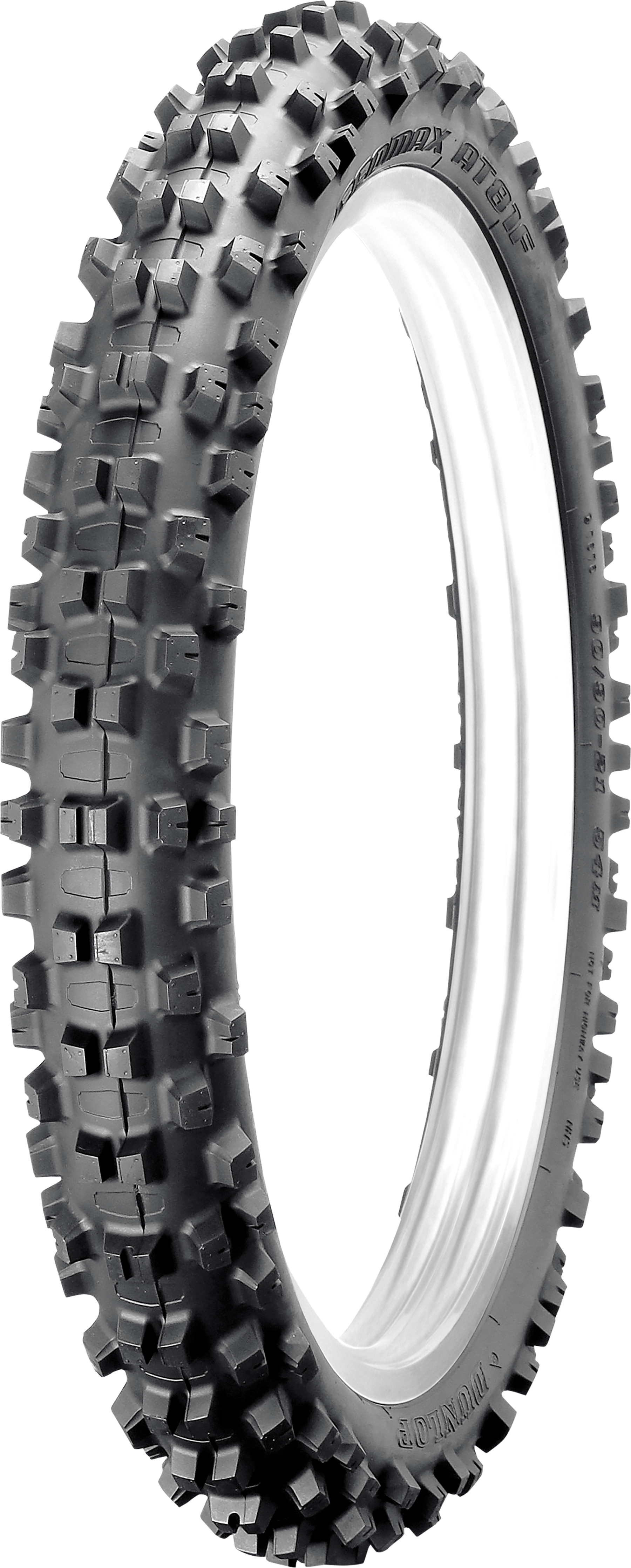
Off-Road Soil Mechanics: Knob Geometry vs. Rubber Durometer
Unlike street tires that generate grip through chemical adhesion and viscoelastic hysteresis against asphalt, off-road knobby tires generate propulsion primarily through mechanical soil shear—digging tread blocks into dirt and pushing against the soil column. Selecting the wrong terrain compound results in either packed-up mud slicks or torn side knobs within a single moto.
| Terrain Classification | Knob Spacing & Profile | Cold PSI Target | Target Track Conditions |
|---|---|---|---|
| Soft / Sand / Deep Mud | Tall, widely spaced directional paddle/scoop blocks (high void ratio prevents mud packing) | 11.0 – 12.5 PSI | Deep beach/desert sand, bottomless mud, freshly ripped wet loam |
| Intermediate (Soft-to-Medium) | Staggered shoulder blocks with tie-bar reinforcement bridges for transitional ruts | 12.5 – 13.5 PSI | Groomed motocross tracks that transition from morning loam to afternoon hard ruts |
| Intermediate-to-Hardpack | Tightly packed, lower-profile blocks with recessed sipes to maximize rubber surface contact | 13.5 – 14.5 PSI | Sun-baked clay, blue-groove hardpack, rocky desert singletrack |
| Gummy / Extreme Enduro | Ultra-soft Shore A durometer compound (~45–50A) that molds around wet logs and boulders | 8.0 – 11.0 PSI (with dual rim locks or soft mousse) | Wet granite, slick tree roots, technical creek beds (not for high-speed MX) |
1. Why Rim Locks Are Mandatory at Low Off-Road Pressures
Street tires rely on 32 to 42 PSI of internal air pressure to clamp the tire bead against the aluminum rim flange. Because dirt bikes run 11 to 14 PSI so the carcass can deform over rocks and roots, the torque of a 450cc engine or violent front braking will spin the rubber tire directly on the aluminum rim—instantly ripping the brass valve stem out of the inner tube. A cast-aluminum and molded-rubber Rim Lock bolts inside the drop center of the wheel (`10 to 12 ft-lb / 14–16 N·m`), mechanically clamping the tire bead to the rim. Never tighten the small brass nut on the inner tube valve stem down against the rim; leave it threaded up against the valve cap so that if the tire slips slightly, the valve stem tilts visibly as an early warning instead of tearing immediately.
2. Standard Tubes vs. Heavy-Duty (3mm/4mm) vs. Closed-Cell Bib Mousses
- Standard OEM Butyl Tubes (1.3mm–1.5mm): Lightweight unsprung mass for groomed motocross tracks, but highly vulnerable to pinch flats (snakebites) when striking square-edged rocks.
- Heavy-Duty & Ultra-Heavy-Duty Natural Rubber Tubes (3.0mm–4.0mm): Three times thicker wall cross-section drastically resists pinch flats in rocky desert and woods riding at the cost of increased rotational weight.
- Closed-Cell Nitrogen Foam Bib Mousses: Solidbutyl/nitrile elastomer foam inserts filled with microscopic nitrogen cells that completely replace the pneumatic inner tube. Simulates an inflation pressure of approximately 12 to 13 PSI (or 7–9 PSI in extreme enduro soft mousses) with 100% immunity to flats. Requires liberal silicone mounting gel inside the tire carcass to dissipate friction heat, and must never be ridden at sustained highway speeds.
Shop Off-Road Tires, Tubes & Wheel Hardware
Browse motocross and enduro tires, heavy-duty tubes, and rim locks in our Tires & Wheels Department or look up OEM wheel sizes in our Tire Size & Cold Pressure Finder.


